"Just build me a static website." We hear it a lot. And honestly? For many businesses, it's the right call. But for others, it's the beginning of a do-over six months later — which costs more than getting it right the first time.
Here's a clear, practical breakdown to help you figure out which one your business actually needs in 2026 — before you spend anything.
What's the actual difference?
A static website is essentially a digital brochure. It shows information — your services, contact details, about page, maybe a blog. Pages are pre-built and served as-is. Fast, simple, and easy to maintain.
A custom web application is software that runs in a browser. It responds to user input, stores and retrieves data, manages accounts, processes transactions, and automates workflows. Think booking systems, client portals, e-commerce platforms, SaaS dashboards — anything where the user interacts and data changes.
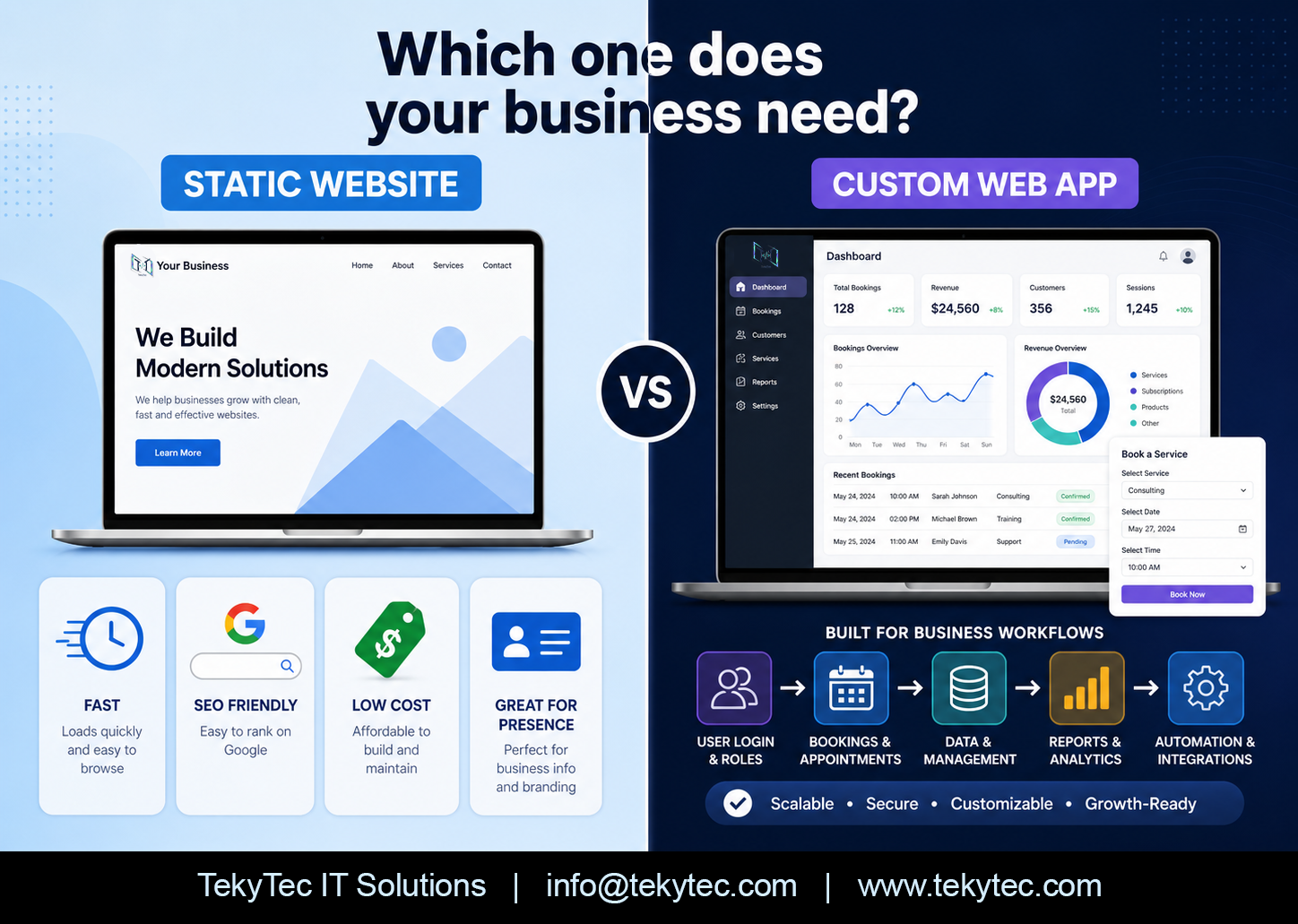
Static Website vs Custom Web Application — a clear side-by-side comparison
Go with a static website if you need to:
- Get your business online quickly with a professional presence
- Show services, a portfolio, or contact information
- Rank on Google (a well-built static site with good SEO is highly competitive)
- Keep things simple — you don't need users to log in or submit complex forms
- Launch fast with a mobile-first, Core Web Vitals-ready build
Modern static websites aren't plain or limited. Built well, they're fast, visually strong, SEO-optimised, and can include AI-powered chat widgets, contact forms, booking integrations, and animations. They're also significantly easier to maintain and secure.
You need a custom web application when you:
- Need user accounts — login, registration, profiles, roles
- Take bookings, orders, or payments that require data management
- Want to stop tracking clients, orders, or reports on WhatsApp and Excel
- Are building a platform other people use (a marketplace, SaaS tool, portal)
- Need to automate workflows or connect to other business systems via APIs
- Are scaling operations and need custom dashboards or reporting
In 2026, a lot of businesses are also considering Progressive Web Apps (PWAs) — a middle ground that gives app-like experiences (offline mode, push notifications, install on home screen) without the cost of building separate Android and iOS apps. If your users are on mobile and engagement matters, it's worth asking about.
The hybrid trap — and how to avoid it
The most expensive mistake we see: a business builds a static site because "we'll add the features later," then realises six months in that the features they need require a complete rebuild. The original site can't be extended — it has to be replaced.
If you already know you'll need user accounts, bookings, or data management — build the web application from day one. Starting over costs more time and money than planning correctly upfront.
A practical decision framework
Ask yourself these three questions:
- Do users need to log in or submit data that gets stored? If yes — web application.
- Does the content change based on who's viewing it? If yes — web application.
- Are you replacing a manual process (spreadsheet, WhatsApp group, paper form)? If yes — web application.
If all three answers are no, a static website will serve you well — and likely perform better in search results too, because static sites are faster and easier to optimise.
What about AI features?
This comes up more and more. AI-powered chat, personalised content recommendations, intelligent search, automated customer responses — these can be added to either a static site or a web application, depending on the feature. Most AI integrations today use APIs, so the question is less "static or app?" and more "which AI tools do you need, and how do they connect to your existing systems?"
If you're not sure, tell us what you're trying to achieve — we'll tell you what actually makes sense for your situation.
At TekyTec, we build both — static sites optimised for speed and SEO, and custom web applications built for scale. Not sure which direction to go? Talk to our team and we'll give you a straight answer based on your actual requirements.